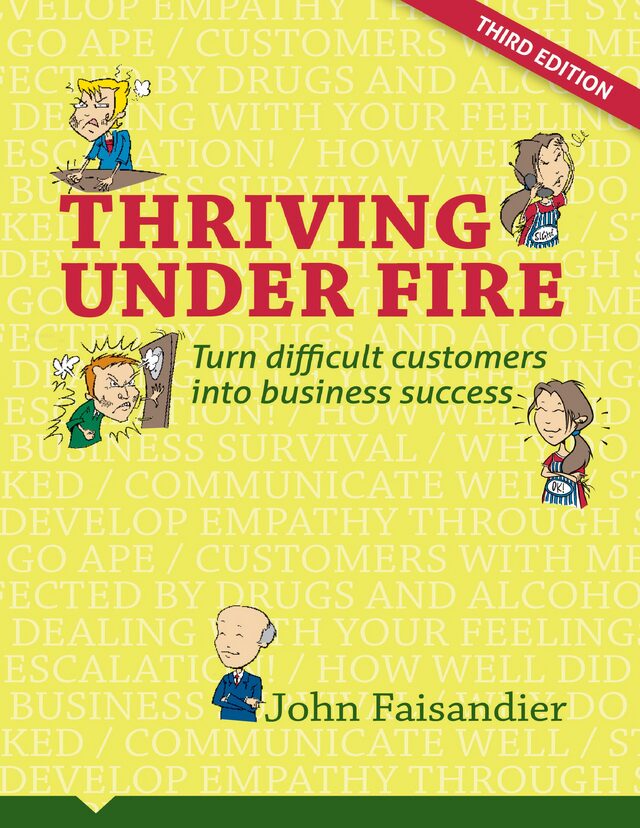
Thriving Under Fire
Turn difficult customers into business success
by John Faisandier
What if the angry customer at your counter is the one who can save your business?
Sophie's Café and Bar has good coffee, good food and loyal regulars, but its owner is losing sleep over the customers who shout, complain and walk out. Through workplace scenes and candid conversations, this practical guide shows how staff and managers can meet anger, criticism and demand without becoming defensive or overwhelmed. Drawing on the TUF: Thriving Under Fire programme, it offers skills for listening, acknowledging emotion and solving problems, with lessons that reach well beyond the workplace.
Business · 118 pages · about 3 hours to read
From the editors
A café owner learns to meet angry customers with calm and care
Angry customers are not bad customers, the author argues. They are people with a problem they care about. The guide follows Sophie, who runs a café, as she talks through real run-ins with a patient adviser. It ranges from everyday complaints to customers with mental health issues, people affected by drugs and alcohol, and refugees and migrants.
The teaching sticks because it is anchored in scenes. When an office manager blames Sophie for afternoon tea sent to the wrong floor, the APE principle (Action, Perception, Emotion) shows why the emotion comes first. Later chapters turn to staff wellbeing: handling your own feelings, caring for your body, and spotting escalation early. Notes point to New Zealand law and further reading.
It suits front-desk staff, small business owners, council and government service teams, and managers who train them.
Perfect for: Frontline and front-desk staff · Small business owners · Customer service team training
What’s inside
- Introduction — Success depends on meeting the demands of internal and external customers.
- Sophie’s Café — Every organisation relies on customers, from retail and government to hospitals and banks.
- Customer satisfaction — your business survival — Customer satisfaction shapes business survival, even in a local retail centre café.
- Why do we get so upset? — Sophie asks why Gary’s blow-up left her hands shaking and heart racing.
- Avoid getting hooked — Sophie’s café has personality, good food and many customers, yet she is struggling.
- Communicate well — Sophie sees the drama triangle and wants to get out of it.
- Stay positive — Sophie reflects on how the ideas affected her after a bad day.
- Change your thinking — Larry studies the menu while others around him demand attention.
- Develop empathy through systems thinking — A sudden outburst frightens Larry and leads into systems thinking.
- When customers go APE — Sophie asks how systems thinking helps with customers who become angry.
- Customers with mental health issues — A man complains loudly about iced water on the morning of a late-night opening.
- Customers affected by drugs and alcohol — A friend from a call centre is invited to discuss customer relations.
- Serving refugees and migrants — Mira and Joseph arrive with baby Zephaniah to talk about serving refugees and migrants.
- Dealing with your feelings — The café is quieter than usual, with Lily, Angus and Rose subdued.
- Caring for your body — Gary confronts Sophie with a list of unresolved complaints.
- Beware of escalation! — An evening opening brings team strategies and a need to manage escalation.
- How well did we do? — Sophie and John reflect on the café scene the morning before his flight.
- Epilogue — Good customer service is essential, and poor responses can harm business and people.
- Getting help — Resources are listed for alcohol, drugs, mental health, refugees and more.
- Acknowledgements — The author thanks workshop participants for their stories and insights.
- About the author — John helps people get on with each other in families, workplaces and communities.
- About the TUF: Thriving Under Fire programme — TUF is a blended learning programme for dealing with emotions at work.
- Notes and references — Notes and references cite workplace safety and related sources.
Read the opening
Why should you care about one grumpy customer? If there were no customers there would be no business. The success of any enterprise — its reputation, efficiency and profitability — is marked by how well you meet the demands of your internal and external customers. This is true whether you are a government department, a local authority, a not-for-profit organisation, a small to medium private business or a multinational company. When the business runs well everyone benefits: the owners, managers, staff, and suppliers as well as customers. This book aims to help you, no matter what part you play in a business or what kind of business it is. When under fire it is sometimes easy to forget that customers are human beings with needs and wants which require fulfilling. Your business only exists when there are real live customers out there connecting with what you’ve got to offer, and each one of them wants to be seen, acknowledged and treated as an individual. This is the essence of customer relations. Emotions are always present when people meet. Ideally a cheery greeting and smile from the staff member invites a cheery greeting and smile from the customer. Responding to customers becomes more difficult when they are angry, frustrated, critical or annoyed. The real test of customer service is how staff respond to people who are expressing these emotions. This is when customers are most sensitive. It’s at these times they notice more keenly if the staff member is for them or against them. Staff who can handle all customers, those who are ordinary and easy to deal with as well as…
The sample pages on this site continue the opening — and the full book is available in print.
Made with Bindery — write and print your own book
Bindery is the book studio inside Infinite Library.